Scontro tra giganti Cina ed Usa in lite per Hong Kong e accordi commerciali

Continuano i botta e risposta nella guerra commerciale tra le due super-potenze, con la Cina che sospende l’import di prodotti agricoli americani.
Partita a scacchi per Hong Kong.

Continuano le tensioni della guerra commerciale tra Cina ed Usa, inasprita anche dalle vicende inerenti al coronavirus con il presidente Trump lancia accuse dirette e senza mezzi termini (approfondimento ai link1 e link2).

Dopo aver tolto 79 prodotti tra articoli chimici e tessuti dalla lista dei dazi (approfondimento al link), la Cina ora ha deciso di sospendere gli ordini di acquisto di alcuni prodotti agricoli americani.

A riportare l’ordine dato dai funzionari del governo cinese alle principali aziende agricole statali, Cofco e Sinograin, è “Bloomberg”. Più nel dettaglio, gli articoli in questione sono quelli alla base dell’accordo di Fase 1 sottoscritto a gennaio e, al momento, l’azione non riguarda le aziende private.

Inoltre, le società cinesi hanno annullato ordini di carne di maiale proveniente dagli Usa per una quantità non precisata.

Nel frattempo, le tensioni sono alimentate per ciò che sta succedendo ad Hong Kong, dove è stato cancellato lo status speciale derivante da un trattato internazionale sottoscritto nel 1997 (e valido per 50 anni) quando la città è passata dal Regno Unito alla Cina.

Pechino, per cercare di rafforzare la sua presa, ha emesso leggi speciali al fine di limitare le libertà di cui Hong Kong gode.

Gallo agli artisti: piantiamo i semi della Felicità e dell’Abbondanza

L’appello del 1°fagotto dell’Orchestra Sinfonica di Sanremo ai colleghi, perché aiutino con le loro armi in questo momento difficile.

In questo momento difficile, ognuno di noi deve aiutare con le armi che possiede.

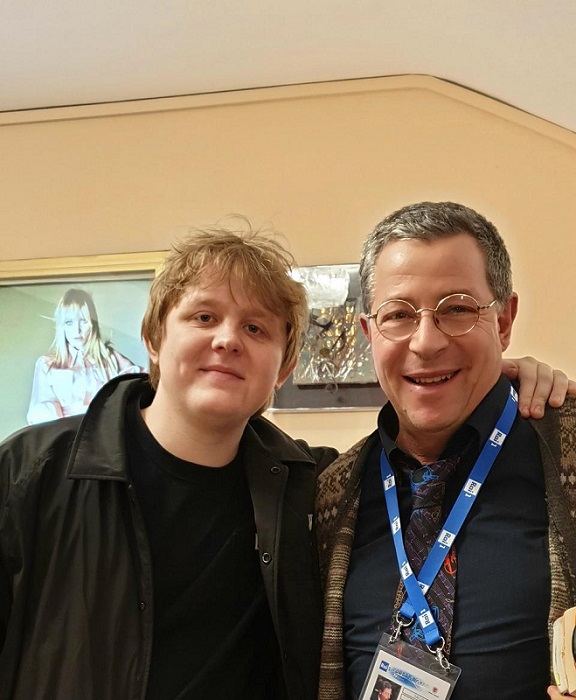
Questa è l’idea di Vitaliano Gallo (in foto con Lewis Capaldi), da 40 anni 1° fagotto dell’Orchestra Sinfonica di Sanremo, che lancia un appello ai suoi colleghi artisti e musicisti:

“In questo periodo dove siamo stati tutti messi alla prova, invito gli operatori del mio settore musica, e nell’arte in genere (in molti lo stiamo già facendo e Li ringrazio), a continuare a pubblicare scritti, poesie, video, così da poter piantare da ora i semi della Felicità e dell’Abbondanza.”

Gallo poi continua, citandole parole di Henry World Bitcher, nelle quali dichiara di trovare molta speranza.

Un’opera di bene può arrivare in forme diverse, la grandezza, non risiede nell’essere forti, ma nel giusto uso della forza. E’ il più grande, colui la cui grandezza, trascina il maggior numero di cuori, grazie all’attrazione del proprio.”

Da parte sua, infine, nel lanciare l’appello il musicista vuole dare il suo contributo con “S-COMPOSIZIONE – Area Sanremo“, che descrive così:

“Memoria e composizione si legano in senso narrativo in giochi della mente, finzioni tracce di melodie, frammenti di opere celebri qui immersi in un linguaggio musicale nuovo e complesso. Riferimenti mnemonici, dalla citazione riconoscibile, allo smembramento del materiale tematico noto, che diviene così non riconoscibile, sino alla ricostruzione di un ambiente sonoro evocato solo dalla suggestione timbrica di uno strumento.”

Coronavirus, Zamagni: “Pandemic will change everything”

Work, bureaucracy, education: a pandemic will purge.
Greater importance for non-governmental organizations.
Italy has always managed, soon they will find new roads.

(Translation by Jolanta Micinska – Hercog)
(Italian version at link)
(Polish version at link – by Magda Żymła)

What coronavirus introduces, among other things, is a dramatic change in our lives, from rules to habits.

And it will also affect the mentality and understanding of the state of affairs.
We discussed this with prof. Stefano Zamagni, former president of the Third Sector Agency, professor at Johns Hopkins University, dean of the Faculty of Economics of the University of Bologna, one of the main collaborators of Pope Benedict XVI in editing the text of the encyclical “Caritas in Veritate” (in 2007-2009) and, from 2019 , president of the Pontifical Academy of Social Sciences.


Professor Zamagni, as Wikipedia also reports, you are a global expert in the field of social economy. What is your point of view on the current situation?

“Look, those who know the Italian character, and here the story is clear, know that Italians have a specific feature: they must reach the edge of the abyss; when they get there, they put off all disputes, roll up their sleeves and start again. It has always been like that. This leads me to the conclusion that when this crisis situation is over, there will be a strong revival of our people’s interest in what we call “the common good.”

What do you mean?

“This pandemic shows us that the” total good “orientation has led to the failure we are now observing. We must replace the adjective “total” with the adjective “common”. This means that people, and above all companies, must act in order to stay on the market in conditions of good development and economic and financial balance, but not only: it is a mistake, and here responsibility also lies with professors of economics, it is stated that the goal the company is maximizing profit for shareholders (shareholder value).”

They say so indeed. What, in your opinion, is the company’s purpose?

“Historically, the company was born with the mission of producing value, or rather creating value. This value cannot be transferred to profit without coverage. Profit must be a share, even significant, in value, but not in everything as it has been in the last 25-30 years.
In this respect, many economists change their point of view.”

And how can you define this change?

“There would be many, but I’m going to pay attention to four points in particular.
The first point is what we just said. The second thing is to understand the correct nature of bureaucracy: today everyone is against bureaucracy, nobody even thinks about talking about it well, but it’s a very serious mistake.”

This is curious. Why?

“Because bureaucracy is not a cause but an effect. The reason for bureaucratization is the search for income, and the search for income is a state of mind that affects both the public and private sectors. This is due to the fact that bureaucracy is an instrument that allows (the state or private entrepreneur) to acquire and maintain rent-seeking positions.

Income is the number one enemy of both salary and profit: the higher the pension, the lower the profit and thus the lower the investment rate in innovation. On the other hand, the lower the salary, the lower the actual demand.
This pandemic will sweep away this mentality because it has shown that if a company does not introduce real innovation, it falls out of the market. Let’s look at a banal and direct example: the only companies that managed to work are those that launched the so-called smart working (15-20%); not only because they placed computers in employees’ homes, but because they changed the organization of work. Until now, again because of the search for profit, companies and organizations do not want to change the way of production, sticking to the outdated model of Taylorism and at the same time losing its resilience.
If we introduce this concept into public administration, we will understand why all political parties, from left to right, want to keep bureaucracy. They all promise to limit it, never doing it: bureaucracy serves politicians to maintain their power.
Enterprises – clearly and fortunately there are praiseworthy exceptions – do not criticize this strongly and firmly, because they themselves fall victim to bureaucracy, and are therefore afraid that by acting against public bureaucracy, it will eventually turn against them.”

So, if I properly follow your reasoning, when we have explained the need to focus on the common good rather than the total good, then we need to work out the causes that generate bureaucracy. Third thing, what would it be?

“The third thing is education.
The structure of the university education sector should be completely changed. The current structure is still the structure of the Gothic reform of twenty years of fascism: a Taylorist type structure where the teacher acts as a workshop manager who checks if students learn their lessons and where the institution functions as a courtroom where young people are assessed and sanctioned (including sense that if the sentence is negative, they fail.

The question is: why, for over seventy years, all political forces have not had the courage to change the fascist system in such an important issue as education? Why was it limited to approving reforms, not transformation?
It is obvious that we must wait for the citizens to organize and speak up if we really want school to become a place of education, not just studying.
Take the case of the reform known as Alternanza Scuola – Lavoro (“school-work alternation”): the one who invented it, I hope, had good intentions, but made a huge mistake! There can be no question of alternation between school and work, but rather of school-work coherence.”

The third point is inherent in education reform, which also applies to what was said at the beginning. And the fourth point?

“Finally, we are dealing with a scandal due to the fact that during this crisis period the third sector was kept out of the way: we have the best third sector in the world among volunteers, social cooperatives, social enterprises, NGOs, foundations and was not involved in the decision-making process .
The social dimension is not guaranteed by the state, hospitals, police or carabinieri, but by the third sector.”

How do you see the situation developing?

“Now that the events have reached the inevitable turning point, you will see that when this crisis ends, it will cause a domino effect.
People have already understood what we have talked about before is just a matter of waiting for some collective entity to start the process. It won’t be long, a few months, by the end of the year at the latest.
And it will not be a matter of finding a leader, they will appear later. Rather, it is a matter of raising awareness of organized civil society.
Once the critical mass is reached, the process of rebuilding the country can begin.
Please go to the website of the “Politica Insieme” association and you will have an idea about the current state of affairs.”
Impatto coronavirus: nasce la filiera italiana dei dpi

Dopo il forte colpo subìto per l’assenza di aziende che producessero mascherine sul territorio nazionale, molte imprese hanno riconvertito la loro produzione.

L’attuale paradigma economico improntato sul neoliberismo ed il capitalismo più sfrenato, ha spinto le aziende a delocalizzare sempre più le produzioni all’estero alla ricerca di manodopera a basso costo e facendoci così trovare impreparati nel momento del bisogno.

Quando le mascherine per proteggersi diventavano introvabili sul mercato ed il loro utilizzo veniva reso obbligatorio per legge, il prezzo è schizzato alle stelle e noi ci siamo accorti che il nostro tessuto industriale era stato spostato oltre i confini nazionali in maniera decisamente troppo marcata.

La risposta di alcune aziende non si è fatta aspettare: 135 imprese, infatti, hanno riconvertito la produzione nel giro di breve tempo facendo nascere la filiera italiana dei dpi (dispositivi individuali di protezione).

A dirlo è Domenico Arcuri, commissario straordinario per l`attuazione e il coordinamento delle misure occorrenti per il contenimento e contrasto dell`emergenza epidemiologica Covid-19, che durante un’audizione informale alla Commissione Affari sociali della Camera sulle disponibilità dei reagenti per l`analisi dei tamponi e dei dispositivi di protezione individuale, ha dichiarato:

“Oggi è nata una filiera per la produzione italiana di dispositivi di protezione individuale, grazie a 135 imprese italiane che si sono riconvertite e hanno iniziato a produrre. Al più tardi entro la fine di settembre, non dipenderemo più dall’importazione di dispositivi di protezione individuale dall’estero (soprattutto dalla Cina, dal Vietnam e dalla Corea del Sud).Abbiamo avviato anche una produzione di macchine per realizzare dispositivi di proprietà pubblica, abbiamo realizzato un accordo con due grandi aziende italiane che stanno producendo 51 macchine necessarie a realizzare mascherine chirurgiche che a regime, entro la fine di giugno, produrranno 31 milioni di mascherine al giorno.”

Coronavirus, Becchi: “Even God Will Not Save Us”

In the name of security, freedom was taken from us. We are trying to stop the virus that has already won: politics, church and constitution have disappeared and with them ages of civilization.

(Translation by Jolanta Micinska – Hercog)
(Italian version at link)
(Polish version at link)

The times we live in are very uncertain. Uncertainty reigns in many ways. The virus is not fully known, from those who identify it with the flu to those who treat it as the worst disease. Therefore, it is not known how to behave: whether to block everything or live a normal life. One thing is certain, however: this sudden change changes.

We talked about this with Professor Paolo Becchi, a former researcher at the University of Saarland in Germany, a scholarship holder of Deutscher Akademischer Austauschdienst (DAAD), then Alexandre von Humboldt-Stiftung, lecturer at the Swiss University of Lucerne and currently a professor of philosophy of law at the University of Genoa.

Our habits are challenges to freedom, which we took for granted.

Professor, what are your thoughts on the current situation?

“The world that appears in my last book „Democracy in Quarantine” written with the participation of Giuseppe Palma, which will be published for the Jubilee next week, presents my point of view, refers to the novel” Blindness “by Saramango. This is a story of a sudden epidemic where everyone has lost his sight. And, in a similar way, we have also become like that because of the virus that has infected our democracy, freedom, conscience and lifestyle. I think there is no point in saying “sooner or later we will beat him” because it has already won. However, it bothers me why I can’t find the answer to how it is possible that the Italian government resigned so quickly from the constitutional provisions on freedom, which was previously considered sacred in the name of “survival”. See, in the name of security, freedom has been taken from us. This is the fact.”

When thinking about a pandemic, the government sometimes has to make difficult decisions to guarantee the protection of human life, don’t you think?

“I understand everything, but there are different ways. It is enough to compare our neighbors. I do not mean Sweden, where the philosophy of action is completely different, let’s look at Germany, where clear laws and sanctions have been established, without restricting movement. What is only an exception with us is a norm for Germans. In South Korea, a smart tracking system was used that does not take away the freedom of 60 million from the public, unlike that used in Italy. A similar system was applied by Zaia in Veneto, which gave very good results. It is also worrying that there is censorship in Italy. The task force has the task of eliminating information which the authorities consider unreliable. “
In your opinion, therefore, is the fault on the political side?
“Of course, and more.
There is a lack of democracy. The state operates on the decrees of the Prime Minister as administrative acts that do not pass the parliamentary vote or the president’s approval. There are also no State-Regions relationship. In Germany, Angela Merkel successively organized meetings with representatives of the Länder, where decisions were made regarding individual regions, always taking into account the balance between freedom and security. In our state, the fault lies also with the opposition, which paradoxically rejected the ball on the opposite side, to the detriment of the citizens. In addition, serious decisions are made on the basis of technical and scientific opinions of “experts” who do not have an unanimous opinion. These scientists decide about our lives, they do not know the answer to the question whether the virus is a form of life or not. We have moved from the state of the right to a therapeutic state. Public opinion and the church are also a problem. “

In what sense?

“There is no information abroad about what the situation really looks like in Italy, because you usually read newspapers such as” La repubblica “and” Corriere della sera “who operate on a task force basis, as I mentioned above. We are forced to quarantine, during which most people watch TV all day, which it broadcasts, which strengthens the right decision on restrictions by the Italian government and that’s what quarantine is for. The situation is typical for an authoritarian regime that creates a climate of fear.”

Speaking of Church responsibility, what do you mean?

“People die without contact with loved ones, alone, without a chance to say goodbye, not to mention the funeral, where they are celebrated in Germany all the time. We have deceased treated as toxic waste. The church has always been sensitive to the sick and suffering, and is silent today. St. Francis hugged lepers, and Pope Francis did not even have the courage to meet what was going on, fighting to preserve the anointing of the sick and a dignified burial. The church has always been present throughout all epidemics. “
What are your predictions for the future?
“We participate in a great social experiment that aims to verify how far you can go to bring the whole country down. This experiment will succeed. It is a country where I did not expect to give up fundamental human freedoms, a Catholic country that would give up the worship of the dead, an anti-fascist country that gave up constitution-based democracy. A state without immunity. The limit has been exceeded, unlike Heidegger, I think that even God cannot save us.”